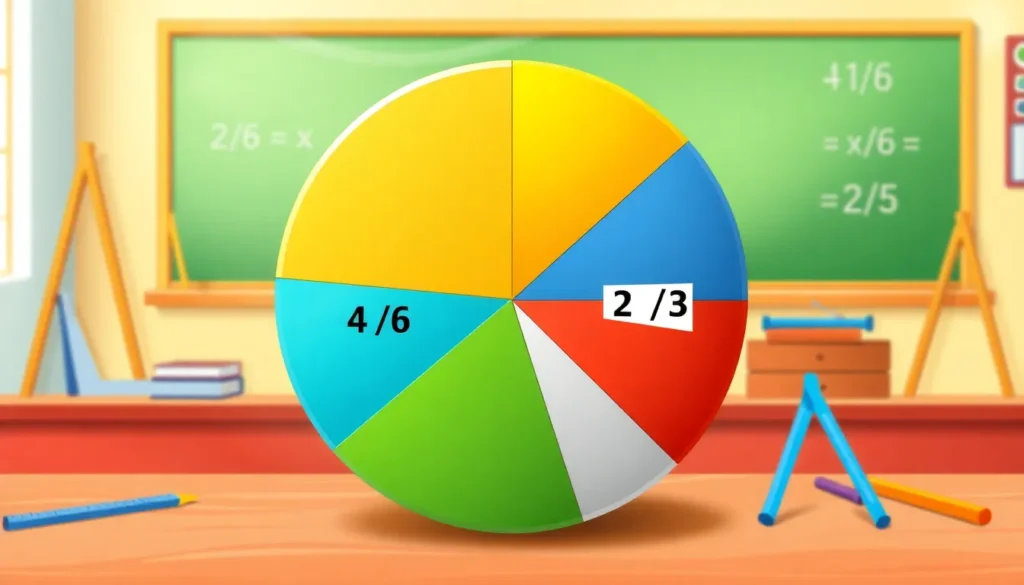

When it comes to fractions, 4/6 might seem like just another number in the math jungle, but it’s got a secret life waiting to be uncovered. What if we told you that this fraction is actually a master of disguise? That’s right! 4/6 can transform into other fractions that are equivalent, and it’s time to explore this mathematical shapeshifter.
Understanding Fractions
Fractions represent parts of a whole and consist of a numerator and denominator. The numerator indicates how many parts are being considered, while the denominator shows how many equal parts the whole is divided into. Understanding fractions helps clarify their role in various mathematical contexts.
Equivalent fractions demonstrate how different fractions can represent the same value. The fraction 4/6 can transform into several equivalents. When simplified, 4/6 reduces to 2/3 because both numerator and denominator share a common factor.
Finding equivalent fractions involves multiplying or dividing both parts by the same number. For example, multiplying both the numerator and denominator of 4/6 by 2 results in 8/12. This illustrates the principle of equivalency. Other examples include 12/18 and 16/24. Each of these fractions simplifies back to 2/3 as well.
Visualizing fractions can aid comprehension. Pie charts or number lines may provide clear representations, helping learners grasp how fractions relate to each other. Seeing 4/6 on a number line alongside its equivalents enhances understanding of their positions and relationships.
Establishing a solid foundation with fractions supports further exploration of advanced mathematical concepts. Grasping the idea of equivalent fractions is crucial for comprehending proportions, ratios, and percentages. Familiarity with these concepts paves the way for success in more complex math scenarios.
Simplifying Fractions

Simplifying fractions involves reducing them to their simplest form. This process makes it easier to work with numbers and identify equivalent fractions.
Key Steps in Simplification
First, identify the numerator and denominator of the fraction. Next, find the greatest common divisor (GCD) of these numbers. After that, divide both the numerator and denominator by the GCD. Doing this results in a simplified fraction, which is much simpler to understand. For instance, in the fraction 4/6, the GCD is 2. Dividing both parts by 2 yields 2/3, the simplified form.
Examples of Simplifying Fractions
When simplifying 8/12, the GCD is 4. Dividing both the numerator and denominator by 4 results in 2/3. Another example is 10/15, which simplifies to 2/3, as the GCD is 5. Notice how each fraction retains its value yet appears in a more manageable format. The same principle applies to 18/24, simplifying to 3/4 with the GCD being 6.
Finding Equivalents
Equivalent fractions represent the same value despite having different numerators and denominators. They illustrate how a fraction can disguise itself in various forms while retaining its essence. For instance, 4/6 and 2/3 are equivalent fractions, as they represent the same part of a whole.
Definition of Equivalent Fractions
Equivalent fractions are fractions that express the same proportion of a whole. Each equivalent fraction results from multiplying or dividing both the numerator and denominator by the same non-zero number. For example, 4/6 transforms into 2/3 when divided by 2. Additional examples include fractions like 6/9 and 8/12, which also simplify down to 2/3, demonstrating the versatility of fractions in mathematical expressions.
Method to Find Equivalent Fractions
Finding equivalent fractions involves specific steps that enhance understanding. Start by selecting a number to multiply or divide both the numerator and denominator. For instance, choosing 2 for 4 and 6 yields 2/3. You can also apply this method in reverse; multiplying 2/3 by 2 results in 4/6. Charting out various multipliers helps visualize the relationships. Other examples could include fractions with multipliers such as 3, generating equivalents like 6/9 or 12/18, further reinforcing the concept of equivalency in fractions.
Calculation of 4/6
Understanding the calculation of 4/6 reveals its equivalence.
Simplification of 4/6
4/6 simplifies to 2/3. The numerator, 4, and the denominator, 6, share a greatest common divisor of 2. Dividing both by 2 yields the simplest form, 2/3. Simplifying fractions makes calculations easier and helps in various applications. For instance, reducing 8/12 to 2/3 also demonstrates this process. Such simplifications emphasize clarity when comparing fractions.
Alternative Representations of 4/6
4/6 can be represented in multiple equivalent forms. By multiplying the numerator and denominator by 2, it transforms into 8/12. Similarly, using 3 leads to 12/18. Identifying alternative representations aids in comprehending fractions better. Many applications rely on recognizing that 4/6 is equivalent to 2/3, regardless of its representation.
In diverse contexts, these representations facilitate deeper mathematical understanding, highlighting the versatility of fractions.
Understanding the equivalence of fractions like 4/6 and its simplified form 2/3 is a crucial mathematical skill. This knowledge not only aids in simplifying calculations but also enhances one’s ability to tackle more complex concepts in mathematics. By recognizing the various forms that equivalent fractions can take, learners can build a stronger foundation for future studies. Visual tools and practice with different examples further solidify this understanding, making fractions less intimidating and more accessible. Ultimately, mastering these concepts empowers individuals to approach mathematics with confidence and clarity.